
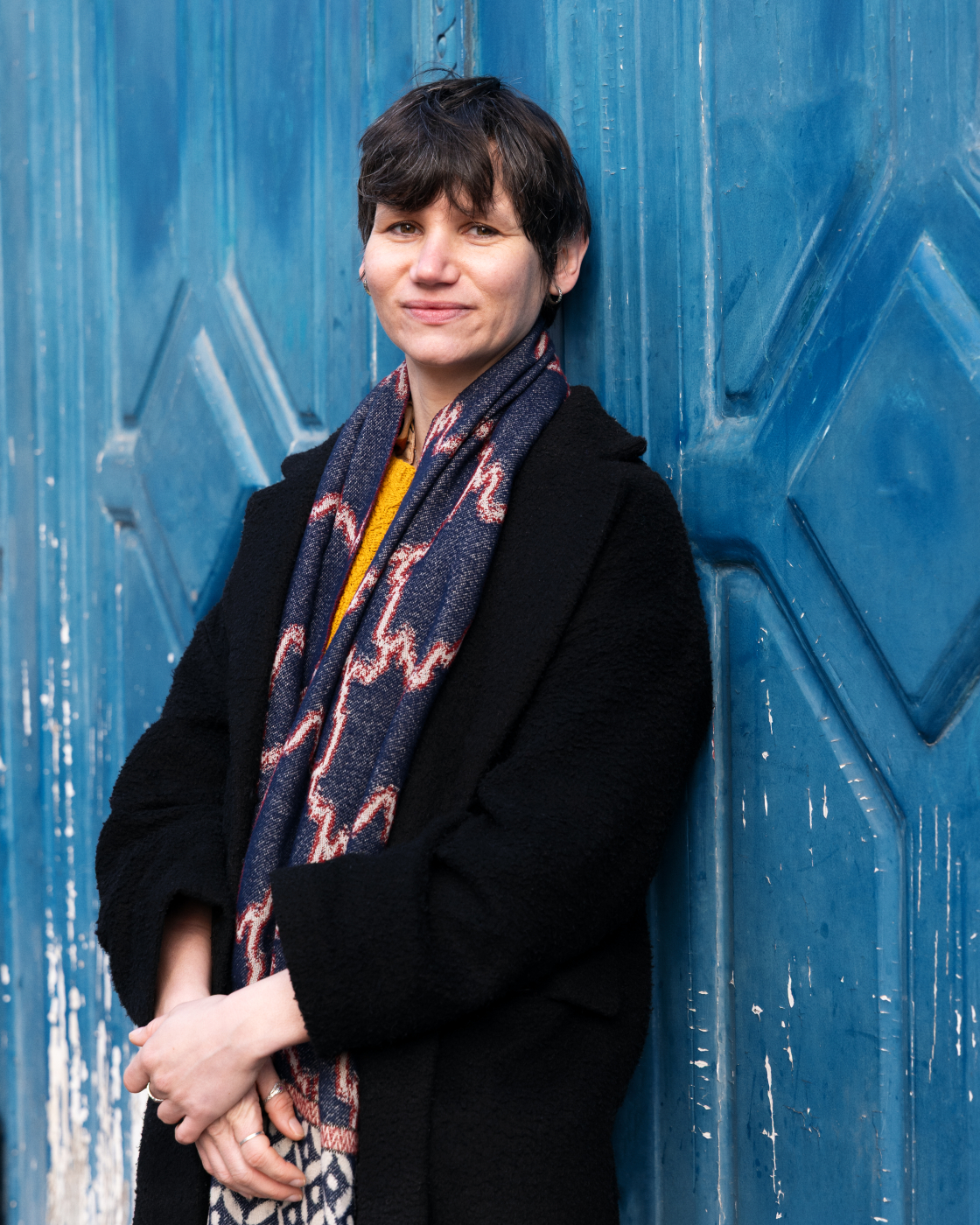
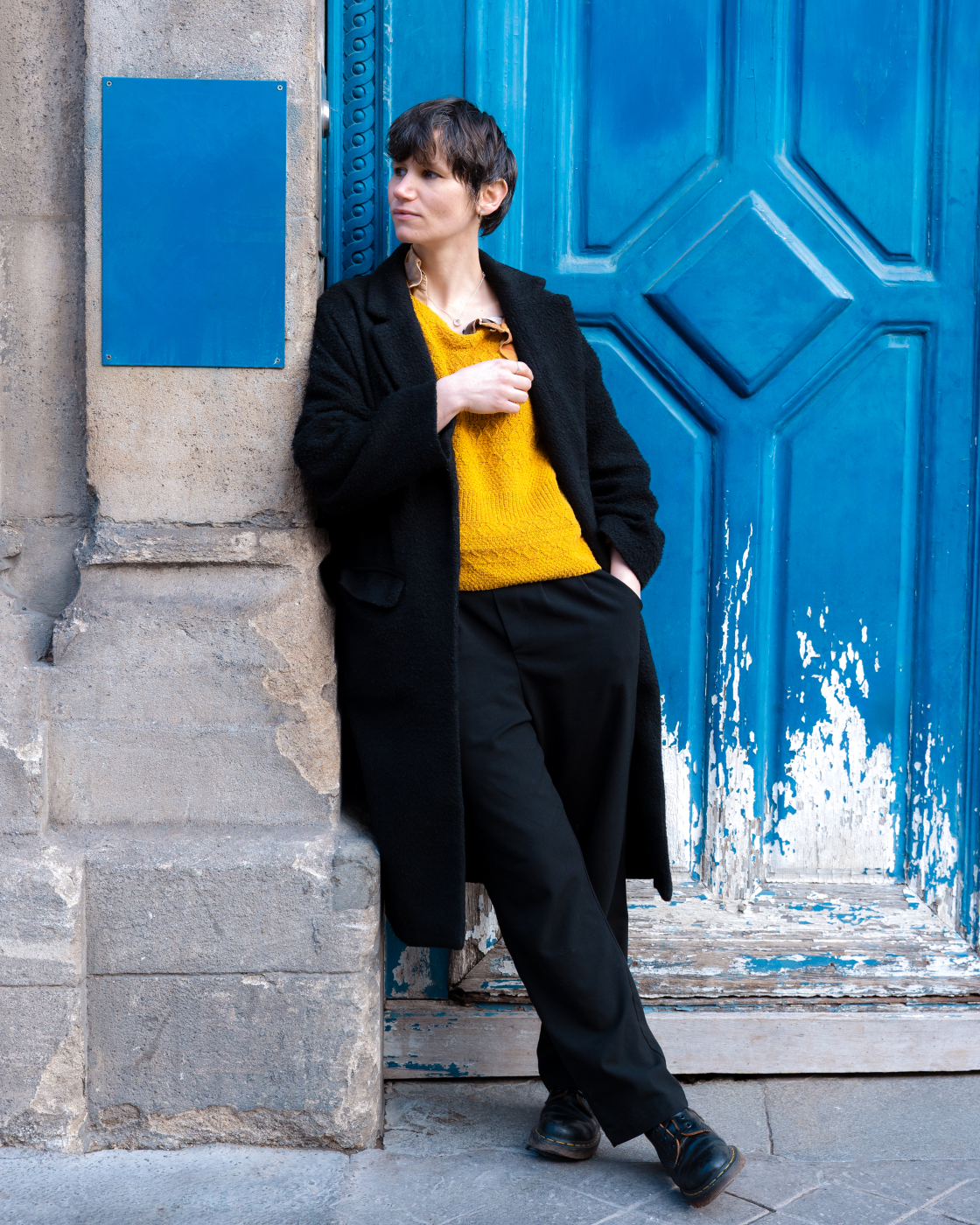
Amélie GRATIAS
Stage Director
Amélie received a creation grant to help her with her play Etnea
What is your artistic background?
My artistic journey didn’t begin with arts, but with sports which, for me, is a form of art. As a teenager, I wanted to become a professional soccer player. I was driven by movement, physical commitment, repetition, effort, and a certain kind of self-sacrifice. I loved the beauty of the gesture and the moment when a movement (sometimes individual but mostly collective) broke the deadlock. And at the same time, I was consumed by a very profound question: what drives a human being to act, to take the plunge, to take action? To explore this, I planned to study psychology alongside my sports career, specializing in criminology.
It was my discovery of theater that turned everything upside down. It was through this discovery that these two passions came together. I found in it a space of radical freedom, a place where the body thinks, where words become action, where personal fractures can be transformed into poetic material. From that point on, I realized that art would be my playground and my realm of exploration. I began by studying film at Paris 7 University. There I learned to observe, to edit, to create rhythm, to craft moving images, an obvious continuity with my organic and performative relationship to the world. At the same time, I was still playing soccer in the second national division and doing amateur theater on Friday nights at the community center in my small village. What seemed like a dissonance or an inconsistency to most people was, for me, an obvious and visceral continuum. Today, I would say that this double, or even triple, life has been the foundation of my entire artistic and professional journey.
I eventually devoted myself to the performing arts. I attended EDT 91 and then the École du Théâtre National de Bretagne, where I developed an artistic approach that blends writing, physical performance, and visual design. There, I also met artists who served as invaluable catalysts. With the support of Steven Cohen, for example, I was able to direct, perform, and create my first piece, Therefore I Am. This first creative endeavor marked a turning point in my career.
I’ve always moved forward by doing. By exploring. By creating in order to understand. After writing and directing two custom-made shows for groups of emerging artists, I founded the company Chambre 2046, which I envision as a camera obscura that reveals the organic foundations of individuals and the imagination that keeps them standing. Driven by this obsession, I wrote, directed, and designed Etnea, a performance for three performers and a moving set design. I would say that my artistic journey has been a transdisciplinary one; most recently nourished by the residency program at the Millennial Academy in Caen, where I refined my stage language and deepened my practice in the visual arts.
Today, this uninhibited ability to move freely between mediums has led me to Le Fresnoy -National Studio for Contemporary Arts- where I am directing my first short film. There, I continue my exploration of the body, its languages, and the way in which significant events permeate the imagination and speech.
How do you view your profession today?
I imagine that in a few years, the way I view my profession now will be different. For the moment, what comes to mind is a perspective that is both affectionate and wary of an act that strikes me as akin to weaving and interpretation (in the sense of translating from one language to another). As an artist, I feel as though I view the world with a certain sharpness, yet one that is steeped in biases that must be approached with caution. My work seems to me to be a matter of combing through words, situations, gestures, and actions, stories and experiences; weaving connections between things and, through this interplay of intertwining and associations, revealing, or rather, bringing back into the light, what was already there but whose effects we did not see or whose full significance we had not grasped. It is striving to listen, to hear, and then to find a way to translate so as to offer to others what has been offered to us.
I have great admiration and affection for this commitment to life; for what strikes me as a testament to generosity. But I also have a touch of mistrust. Because I fear inconsistency, arrogance, and thoughts reinforced by confirmation bias, like those algorithms that trap us within a single imaginary world, a single value system, a single iconography, and create feelings of certainty. Too much certainty. I also fear burnout, the infernal machine that cuts us off from our own sensations and those of the world, from the concrete reality of living together. Sometimes I fear an artistic profession that cuts me off from others in daily life, in the concrete reality of village life, I want to say, that of my parents, my brothers and sisters, my nephews and nieces, my neighbors, the people I encounter here and there. And I remember that it is this very profession that also allows me to truly see them, that shifts my perspective and reveals them to me in all their humanity. To love them, to be surprised by them, to be amazed, to be inspired, sometimes outraged too, to be angry, and then to have the chance to put words to it, to work this material over, to transform it into something else, into sensations, emotions, form, sound, voice. And to be moved together during a performance, a film, or a reading.
How do you see yourself in 5 years? In 10 years?
Since 2021, I have been engaged in a creative process that explores the impact of trauma on body language, speech, and the imagination. Creating takes time. So does understanding what is at play in our artistic practice. The production of a work spans several years. I am currently working on my first short film, and in response to it, I am developing a stage performance. Next year, a second short film will be released, while Etnea will take off on tour. So in five years, I imagine I’ll be consolidating this first cycle. Or perhaps bringing it to a close? I don’t know.
I really like this question: How do we see ourselves in 5 years, in 10 years, in 20 years? When I worked with students from the Arras Conservatory at the invitation of Tandem-Scène nationale, and continued this exploration with the graduating class of EDT 91, with whom I created Au Seuil, I was struck by a response that came up often. To the question “What did you dream of as a child? What do you dream of now?”, I heard several times: “It’s hard to dream of a future in a world where we’re constantly being told it’s going to collapse.” Between the global political and economic climate, violent conflicts, the increasingly repugnant revelations of the perversities the powerful are capable of, and the climate crisis, are we today capable of envisioning ourselves, of imagining what we might be like in 10 years?
I’m in my thirties, an age that I believe marks a kind of maturity that sets in gradually or that one discovers. It’s an age when we begin to understand ourselves, to grasp our inner workings, and when we can realistically envision making changes. Naturally, this leads me to imagine that in five years, I’ll be consolidating my creative work, this desire to write and create works that aren’t constrained by labels, moving unabashedly from live art to filmmaking or digital creation.
In 10 years, I’ll be in my early 40s. It’s an age I know nothing about, except that I find it beautiful in other women. Reading The Art of Joy by Goliarda Sapienza filled me with a deep sense of joy at the thought of maturing and growing older. I often say that I can’t wait to turn 45, to turn 55. Fueled by that fantasy, in 10 years I see myself as more confident, calmer too, healed from certain wounds that are still raw, perhaps with the ability to create without burning out? And equipped enough to discover other creative possibilities. Why not write a novel? Or design a sculpture? To open up new types of collaborations? Or then again… like Claude Régy, in 10 years I’ll still be plowing the same furrow, because we never stop discovering, and as long as what I’m exploring today continues to fascinate and amaze me, there’s a good chance I’ll keep working with it.
There’s also a world, a life running parallel to my own, where I’ve given up everything to open a coffee shop or a crêperie. Or another one where I devote myself to setting up climbing walls to create routes with movements that are beautiful, complex, and exciting for climbers to experience.
There will always be some form of writing. I can’t imagine myself 10 years from now without the urge to write or put my thoughts down in some way.
Interview conducted in 2026
Photographs taken in 2026 by Yama Ndiaye