
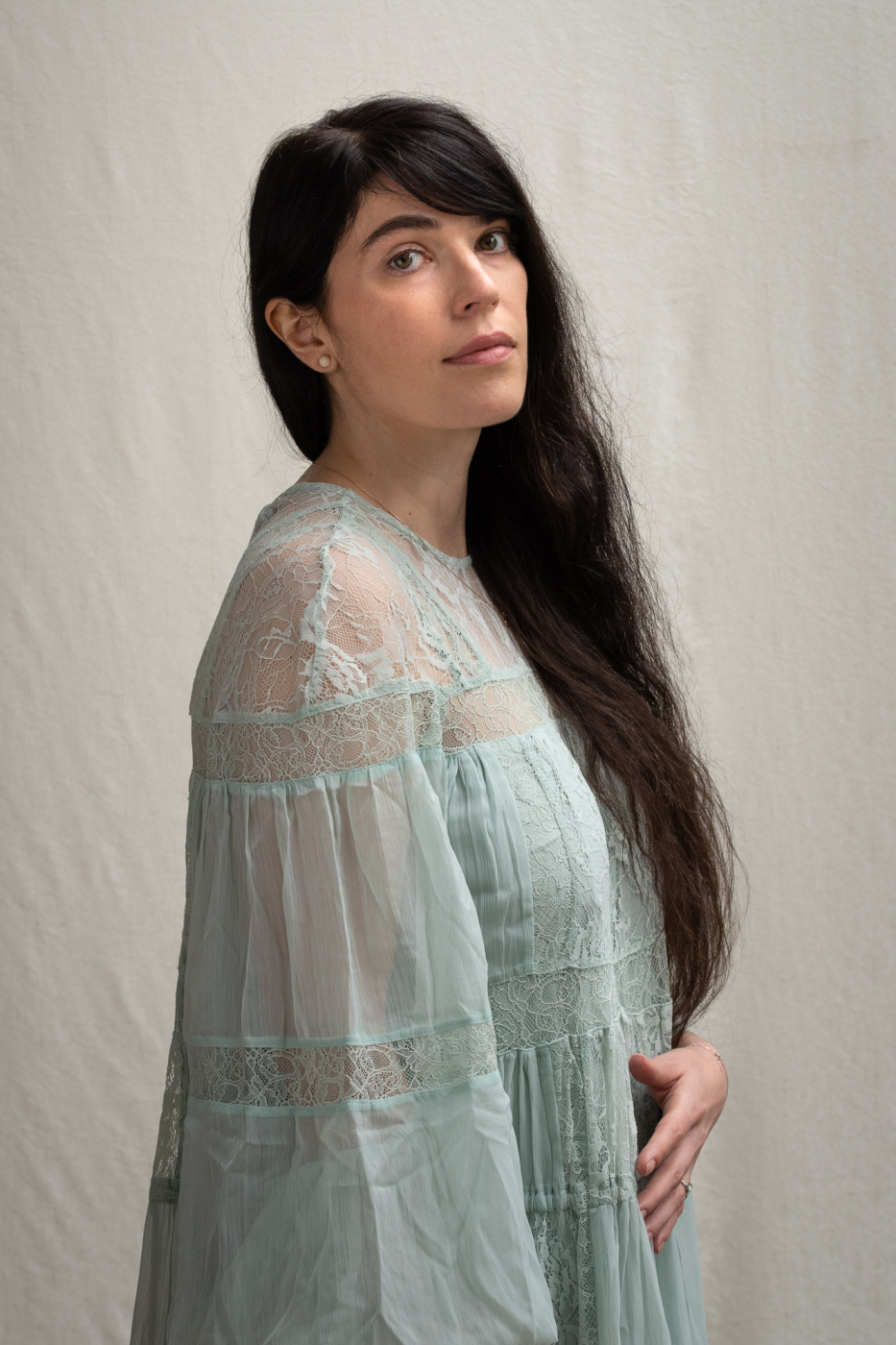

Camille MICHEL
Photographer
Camille received the grant "Emerging creation" as part of the LES FEMMES S'EXPOSENT festival in partnership with the Fonds Régnier pour la Création.
What is your artistic background ?
I grew up in a small rural village in northern France. I studied art at Paris 8 University, then photography at the École Nationale Supérieure de la Photographie in Arles. Concerned about environmental issues, I am a photographer committed to ecological issues and the polar regions. Through numerous reports in the Arctic, I highlight the lives of small communities facing the challenges of the modern world—such as climate change, pollution, and resource exploitation—while revealing their remarkable ability to adapt.
In recent years, my work has focused on the Inughuit, an indigenous people of northern Greenland with a population of only about 700. Living mainly from traditional fishing and hunting, they show a deep respect for nature. Their way of life reminds us of the crucial importance of preserving the balance between humans and their environment in order to ensure a sustainable future for all. As the first victims of climate change, they embody the upheavals of our planet and stand as true sentinels of the ice.
I regularly exhibit in France and abroad (Palais de la Découverte, Rencontres d’Arles, Pudong Museum Shanghai) and my work has been published in numerous media outlets such as Le Monde, Libération, and The New York Times. I have won several awards, including the Libération Prize, the François Schneider Foundation Prize, and, in 2024, the Les Femmes s'exposent festival grant, jointly awarded by the Fonds Régnier pour la Création and the Fonds Porosus. Inspired by the work of Jean Malaurie, I am currently working on a photography book dedicated to the promotion and protection of the indigenous peoples of the Far North.
What is your view on your profession today ?
It is a profession that, in my opinion, is not always sufficiently recognized or valued, even though it plays an essential role in our society. Documentary photography allows us to bear witness to often overlooked stories, to report on complex realities, and to show what is happening beyond our everyday lives. Through images, it is about telling stories, informing, and communicating—whether in the pages of a newspaper, in an exhibition, in direct contact with the public, or through educational projects in schools. This work is essential for conveying authentic testimonies, far removed from biased images or simplified and often slanted narratives. In a world facing major challenges such as climate change, this fieldwork is more necessary than ever. It makes visible the concrete consequences of global phenomena on human lives and raises awareness of issues that concern us all.
It is a demanding profession, often financially precarious, but deeply driven by passion and commitment. Many photographers are involved in causes that go far beyond their artistic practice. With the emergence of artificial intelligence and the proliferation of fabricated images, I believe it is crucial to preserve this human dimension and this demand for truth, embodied by those who go out into the field, observe, listen, and bear witness to reality.
For my part, with each report, I spend long months immersed in the communities I photograph, living as they do. This almost anthropological approach allows me to understand the issues in depth and to convey not only facts, but also emotions, experiences, and perspectives. It is this humanity, this authenticity of testimony, that gives this profession its strength and necessity. It must not disappear.
How do you see yourself in 5 years? In 10 years ?
I hope to continue traveling among indigenous communities, telling their stories and bearing witness to their lives. I see myself living closer to nature and would like to start writing a book compiling my field reports. But more than anything, I want to continue marveling at the beauty of the world, as an act of resistance.
This interview was conducted in 2025
Photography credit: Isabelle Chapuis